Driveway gates
Driveway gates built for the driveway you have.
Swing and slide gates measured against the real slope, the real swing clearance and the real opener duty — so it works the same on day one thousand as on day one.
- Configurations
- Swing & slideSingle or double leaf.
- Automation
- Opener-readyBuilt for the motor from the start.
- Estimate
- FreeSite visit for anything structural.
- Coverage
- Serving the East BayHayward and the East Bay.
What we build
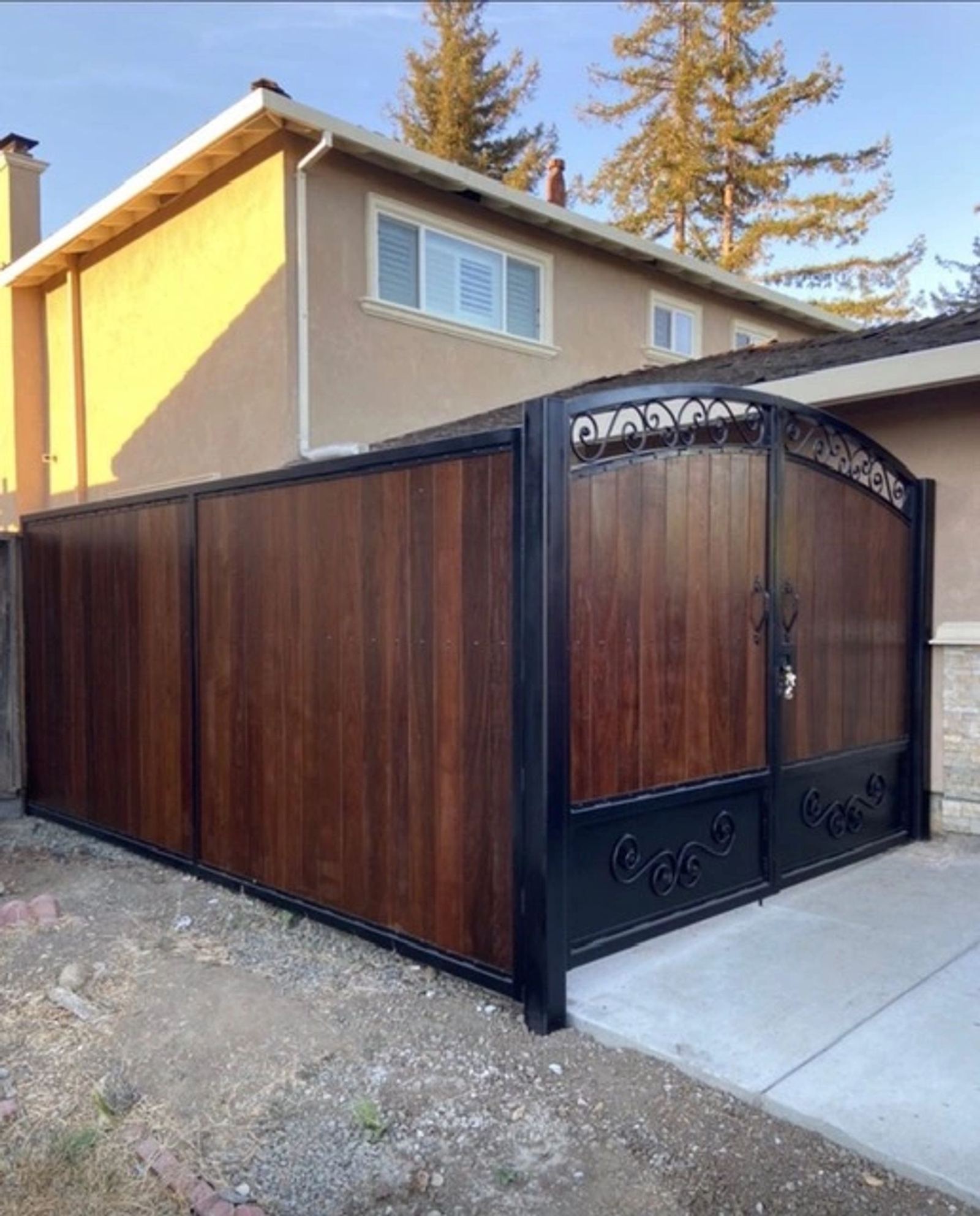
Double-swing driveway gates, single-leaf gates on narrower drives, slide gates on a track or a cantilever, and combination openings where a driveway gate and a pedestrian gate share one run of metalwork so they read as a single entry rather than two separate jobs.
A driveway gate is the largest single piece of metalwork most homes will ever carry, and it is the one people see from the street. Both of those things are true at once, which is why the structural decisions get made first and the decorative ones second.
Why the slope matters more than the width
A level opening is the easy case. Most driveways are not level — they rise from the street, or crown in the middle, or fall to one side for drainage. On a swing gate, that slope decides whether the leaf clears the ground through its whole arc or grinds at one point. On a slide gate, it decides whether a rolling track is even viable or whether the gate has to be cantilevered clear of the ground.
Which is why the measurement happens on site with a level, not from a photograph. A photo tells us what you want; the driveway tells us what will work.
Built for automation, whether or not you automate now
A motorised gate cycles thousands of times a year, and every cycle loads the hinge side. That is a different design problem from a gate a person pushes twice a day.
If automation is in the plan — now or later — the gate gets a heavier hinge post in a deeper footing, hinges with real duty margin, a frame braced against the racking that repeated motor starts induce, and conduit run to the post while the trench is already open. Adding all of that later means digging up finished work.
- Hinge post and footing sized for motorised duty, not hand duty.
- Conduit and a pull string run to the post during install.
- Frame braced so motor starts do not rack the leaf out of square.
- Clearances and mounting points the operator manufacturer requires.
Infill, privacy and wind
Solid infill on a wide gate is a sail. Wind load on a fully panelled driveway gate is real, and it goes straight into the hinge post and the footing — a gate that would be fine at four feet of picket can need a substantially bigger post at the same width in solid panel.
Vertical pickets pass wind and let you see the street. Horizontal slats at a tight spacing give most of the privacy of a solid gate while still breathing. Wood or composite boards in a steel frame give complete privacy, and get designed with the extra post and footing that choice demands rather than being bolted onto a frame sized for pickets.
Privacy has a structural price
If you want a solid-panel driveway gate, the honest version of that quote includes a heavier post, a deeper footing and often a stronger operator. We would rather show you that at the estimate than build the light version and have it lean in the second winter.
How the estimate works
Driveway gates get a site visit. Ground slope, footing depth, what the leaves would swing into, where power can reach and how the gate meets the fence line all affect the real price and none of them read reliably off a photograph.
Start by texting (510) 363-2490 a photo of the driveway from the street and a note on whether you want it automated — that is enough to tell you whether we are talking about a swing or a slide, and to book the visit.
Projects
Driveway Gates we’ve built.
Photographed on completed jobs. Measurements and pricing come at the estimate, on your own opening.
Supplier catalogs
Colours and components you can look at before you decide.
These are the suppliers whose catalogs get opened on ATR jobs. Read them as a starting point rather than a menu — what is actually right for your piece depends on the design, the exposure and how it gets fabricated, and we will confirm that at the estimate.
Gate operators and access
An automated gate is two decisions, and the second one gets forgotten. The operator has to be sized to the gate ATR builds — weight, leaf length, duty cycle, slope. The entry side is how a visitor, a delivery or a tenant actually gets in. Both are cheaper to design in now than to retrofit later, which is why we ask about them at the estimate.
- Open operators catalog
Gate Operators
Swing and slide operators with the capacity charts — leaf weight and length against duty cycle. This is the section that decides whether a gate design is automatable as drawn.
- Open accessories catalog
Gate Accessories
Loop detectors, photo eyes, edge sensors, keypads and the safety hardware an automated gate needs to be legal as well as convenient.
Composite and wood infill
On a privacy gate or a solid fence panel, the steel is the frame and the infill is what you actually look at. Composite board is the usual answer where nobody wants to be restaining timber every few years. Browse the colours, then we will detail the frame around whatever you choose.
- Browse Trex collections
Decking Collections
Board colours and profiles across the Trex lines. Deck boards, but they cut down and fit a gate frame the same way.
- Browse TimberTech collections
Deck Collections
Composite and PVC board ranges. The PVC lines hold colour noticeably better on a west-facing gate than the entry-level composites.
Powder coat colour
Powder coat is where nearly every colour decision on a job actually gets made. These are the colour cards ATR works from — pick something you like, bring the code to the estimate, and we will tell you honestly whether it suits the exposure that piece is going to live in.
- Open Essentials colour card
Essentials, Volume 6
The standard range — the colours most jobs land on, in the gloss levels and textures they are actually available in.
- Open Super Durable card
Super Durable, Volume 3
The range worth reading if the piece faces south or west. Super durable powders hold their colour years longer under direct sun than standard polyester.
- Open Metallics card
3D Metallics, Volume 2
Metallic and effect finishes, for when a flat colour is not the look. They read very differently in person than on a screen — treat the card as a shortlist, not a decision.
- Open Cardinal colour card
Powder Coatings Colour Card
A second full colour card, from a West Coast powder manufacturer. Useful as a cross-check when a colour you want is not stocked in the TIGER range.
ATR Welding is not a dealer for, affiliated with or sponsored by any company listed here. Catalogs are published by those suppliers and open on their own sites; availability, colour ranges and specifications are theirs to change. See every catalog in one place →
Driveway Gates
What people ask before booking.
Swing or slide — how do I know which one my driveway needs?
Swing is simpler, cheaper and quieter, and it is the right answer whenever there is clear, level space for the leaves to open into. Slide is the answer when there is not: a driveway that rises away from the street, a swing radius that would land on the sidewalk or a parked car, or an opening too wide for two leaves to stay rigid. Slide costs more, has more hardware and more that eventually needs servicing, so nobody should be sold one who does not need one. We look at the actual driveway before recommending either.
Do you install the automatic opener as well?
We fabricate and install the gate, and we build it to carry an opener: a reinforced hinge post, hardware rated for motorised duty, and the clearances the operator needs. Whether we install the motor itself or coordinate with an opener installer depends on the job and on the operator you want. Say at the estimate stage that the gate will be automated — retrofitting an opener onto a gate that was not built for one is where most driveway gate problems start.
Does a driveway gate need a permit?
It depends on your city and on what the gate does. Height, whether it swings into a public right-of-way, whether it is part of a fence that itself needed a permit, and whether it is motorised all factor in. We will flag a job that looks like one that needs a permit, but your planning or building department has the final say. A five-minute call to them before the gate is fabricated is worth far more than one afterwards.
Steel or aluminum for a driveway gate?
Steel is stronger for the same wall thickness and is the usual choice for a heavier, security-focused gate, and for anything wide enough that stiffness matters. Aluminum will not rust, which matters on a gate nobody is going to repaint. Weight also decides the operator: a heavy steel gate needs a stouter motor, which costs more up front and draws more every cycle. We ask how the gate will actually be used before recommending one.
What about safety devices on an automated gate?
A powered gate is a moving vehicle-sized object, and the industry standards for gate operators exist because of the injuries that happen when one is installed without entrapment protection. Photo eyes, edge sensors and reversing behaviour are part of the operator installation, not optional extras. We build the gate to accept them and will not spec an automation setup that skips them.
Free estimate
Send a photo of the driveway.
We'll tell you swing or slide, what it needs structurally, and a real price — before anything is scheduled.
Licensed, bonded and insured — CSLB #1037852. Free estimates, no obligation.
Based in Hayward. Serving the East Bay. Not sure if it’s something we do? See the full list of services, or book a consultation.